Ever since HIV was discovered to be the cause of AIDS in 1984, researchers have been on a quest to finding a vaccine for it. However, after about forty years of research, finding a vaccine for this deadly virus seems to be elusive. Researchers are not deterred as they are still in the process of developing preventive HIV vaccines that can be given to individuals who do not have HIV. The goal of developing and administering HIV vaccines is to prevent HIV infections in the future. A preventive HIV vaccine teaches a person’s immune system to recognize the virus and effectively fight against HIV should s/he get exposed to HIV.
There are several myths surrounding HIV vaccines. As today marks World AIDS Vaccine Day, DGG would like to inform you about these myths and help clarify them:
MYTH 1 – There are pills that can prevent HIV hence an HIV vaccine is not necessary.
HIV-negative persons who are at a high risk of contracting HIV can take antiretroviral (ATR) drugs called PrEP (pre-exposure prophylaxis) daily to lower their chances of getting infected if they become exposed to the virus. However, these drugs are expensive and not everyone might be able to afford it. Also, they must be taken daily and consistently for it to work effectively but not everyone might be able to do it, as it can be a challenge for some people to remember to take their pills every day. But with vaccines, they need not be taken every day and are very affordable. Considering how smallpox, for example, has been eliminated through the use of vaccine, it can be concluded that the most effective way to eliminate a disease is by using an effective vaccine.
MYTH 2 – Vaccines cause autism therefore they aren’t safe.
This is not true as there has been no research finding that has proven a relation between childhood vaccination and autism. Indeed, there might be some mild side effects of vaccines such as lethargy, sore throat, muscle aches and fever which are only temporary and might go away after a few days. Also, researchers who make the vaccines make it their priority to protect candidates that volunteer to take vaccines and for that reason won’t put the lives of volunteers at risk.
MYTH 3 – Western scientists are unfairly using people in developing countries to test HIV vaccines.
This is also not true. To develop an effective vaccine, it is important that it is tested on all kinds of people to testify that the vaccine works on all kinds of people. Hence the testing is done in different parts of the world at the same time. The same procedures and international standards are also followed irrespective of where the testing occurs.
MYTH 4 – An HIV vaccine already exists.
This is false. As indicated previously, there are currently no licensed vaccines against HIV/AIDS neither is there a cure for HIV but scientists are still working at developing an effective vaccine against HIV.
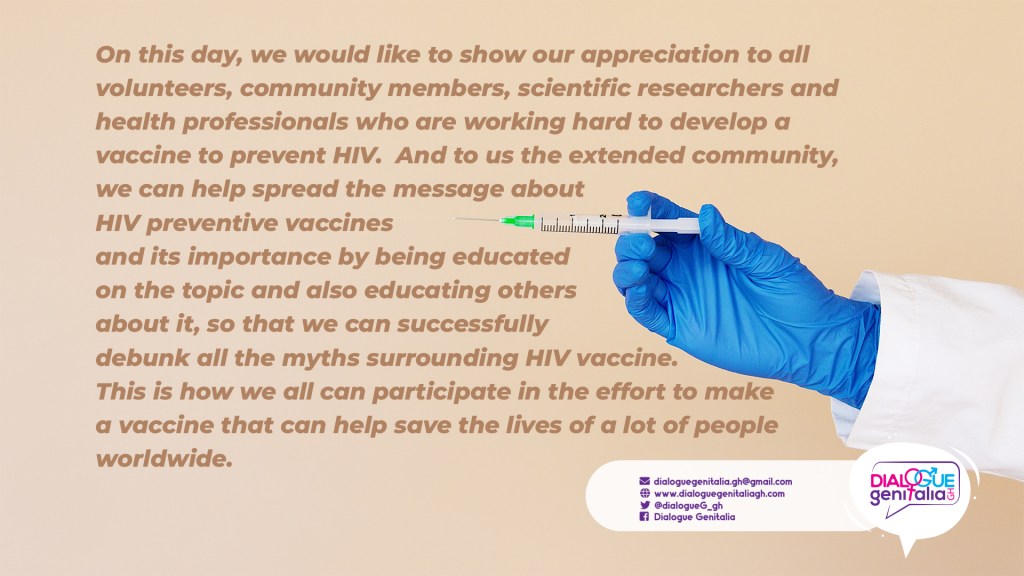
On this day, we would like to show our appreciation to all volunteers, community members, scientific researchers and health professionals who are working hard to develop a vaccine to prevent HIV. And to us the extended community, we can help spread the message about HIV preventive vaccines and its importance by being educated on the topic and also educating others about it, so that we can successfully debunk all the myths surrounding HIV vaccine. This is how we all can participate in the effort to make a vaccine that can help save the lives of a lot of people worldwide.
 Dialogue Genitalia - Ghana
Leave a comment