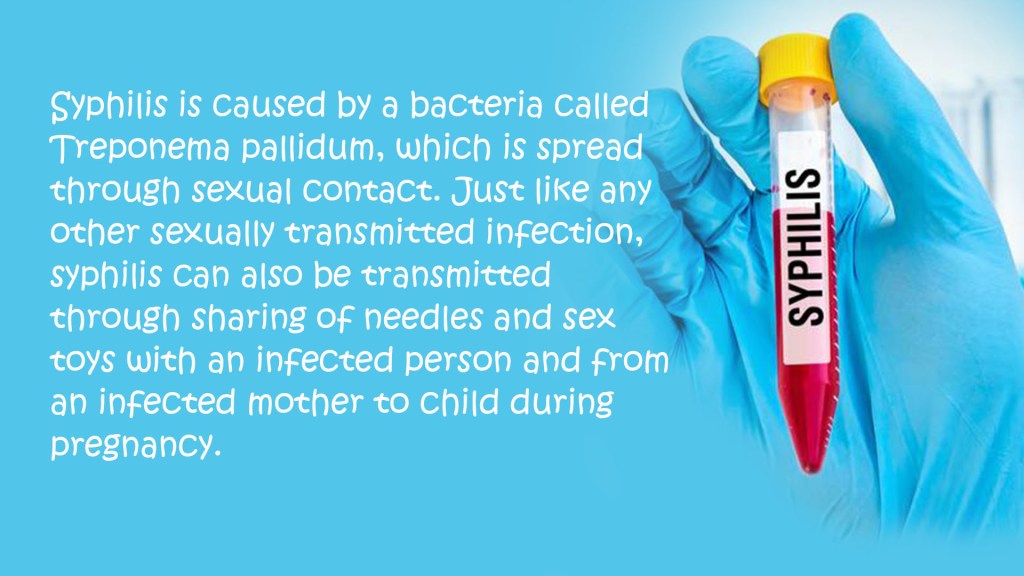
We continue our series on STIs/STDs by taking a critical look at some facts about Syphilis – another challenging infection. Syphilis is caused by a bacteria called Treponema pallidum, which is spread through sexual contact. Just like any other sexually transmitted infection, syphilis can also be transmitted through sharing of needles and sex toys with an infected person and from an infected mother to child during pregnancy. It causes infectious sores and rashes on or around the penis, vagina, and anus and in the mouth.
Syphilis develops in stages and symptoms tend to differ with each stage. These stages are divided into primary, secondary, latent and tertiary. During the primary stage, symptoms appear 10 – 90 days after exposure. An infected person at this stage generally develops painless sores around the genitals, anus, or mouth. These sores are usually less than 2 cm in length and circular shaped in nature. The sores may go away naturally, but without treatment, the infection progresses, leading to more health complications. During the secondary stage, which occurs 2 weeks to 6 months after exposure, the infected person develops fever or headaches and rashes every so often on their hands and soles of their feet. Such individuals may also experience swollen lymph nodes around the neck. Both the primary and secondary stages tend to be mild and may go unnoticed. During the latent stage, which occurs 12 – 24 months after exposure, the infected person will show no symptoms. Such a person may live so many years without any possible symptom of the infection. When left undetected and untreated, syphilis progresses to the tertiary stage. During this stage, the infection causes irreversible damage to internal organs in the body such as the heart and central nervous system, leading to loss of vision, hearing and eventually death.
It is recommended that sexually active persons get tested occasionally. Beyond the blood test, healthcare professionals may also examine the mouth and genital areas to check for sores and rashes. Persons who test positive for syphilis should also test for HIV, because contracting an STI like syphilis can increase the risk of getting infected with HIV. Syphilis can be effectively treated through the use of antibiotics provided to patients upon diagnosis. Even though treatment is effective, reinfection is also a huge possibility. To lower your chances of infection, we should embark on the following measures;
- Again, abstinence is the only effective way to prevent the spread of STDs, especially for young and unmarried persons.
- Reduce your number of sexual partners to one who has been tested for syphilis and does not have syphilis.
- Use a new condom each time you have sex and be sure to wear it correctly.
- Use sterilized needles or sharp objects and do not share used needles, sex toys and sharp objects with anyone.
- Seek medical attention before drug use and seek medical care during pregnancy.
- Get tested and treated for other STDs and encourage your partners to do the same.
Do join us in our subsequent posts as we discuss other STIs, their psychological implications and preventive measures as well as the treatment options that are available to combat STDs.
 Dialogue Genitalia - Ghana
Leave a comment